 There are five traditionally accepted branches of philosophy: metaphysics, epistemology, politics, aesthetics, and ethics. Each branch answers specific questions that have a profound impact on our lives. Because each branch is focused on answering particular types of questions, it is possible for different branches to give different solutions to the same problem. Consider the branches of aesthetics and ethics. Aesthetics is concerned with the questions of what is beauty, what is ugliness, and how can beauty improve our lives, while ethics concerns the questions of what is right, what is wrong, and how can we make the best decisions. It might seem strange to some that these two branches can be confused with each other, but consider the following scenario where a person uses aesthetics, the awareness of beauty, as their approach to solving a problem.
Henry adores his daughter Beth’s smile. Nothing pleases him more than to see Beth smiling beautifully; likewise, the sight of his daughter crying fills him with revulsion. One evening, Beth comes to Henry and asks if she could have some extra dessert. Henry asks what her mother has said about this. Beth breaks down into tears and says that her mother has told her she isn’t to have any more dessert tonight unless she cleans her room. Henry recoils from the sight of his lovely daughter’s face spoiled by tears and he wishes he could gaze upon her cheeky, beautiful smile again. So he tells her that of course she may go and have some extra dessert. Beth’s face lights up with joy and Henry feels happy to see his favourite smile in the whole world again. Continue reading
 Never been to therapy before? Wondering how it can help? Curious about the therapeutic process? Each year, tens of millions of people seek therapy for a variety of reasons. Not all therapists are the same, though; there are many different schools of thought. Even within the same school, each therapist is unique in their approach to the therapeutic process. Philosophical therapists were arguably the first therapists in history, but are relatively few in numbers of practitioners today compared to the mainstream schools like behaviourism, psychoanalysis, and gestalt, just to name a few. Because philosophical therapy is different to most of the other schools, I have written this article to cover the most basic process of the philosophical therapeutic process.
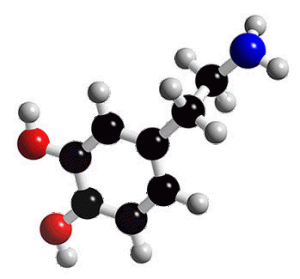 Lack of motivation is a common complaint in the 21st century. Many people talk about feeling a lack of motivation. There are many factors that control how motivated a person feels: incentives, deterrents, personal interest, cognitive dissonance, past childhood traumas, and dopamine levels all rate highly. Each of these topics deserves an article in its own right, but for this topic, however, this article will concern itself merely with self-esteem and dopamine levels. Furthermore, it will act simply as an introduction to the topic of dopamine and its relationship to motivation. If you are interested in this topic, you are urged to do your own further research, as this article will not be an in-depth academic piece. There are a few links at the bottom to get you started.
 Philosophical Therapist